



NTC Temperature Sensor Helps Prevent Thermal Runaway in Electric Vehicle Drive Motor
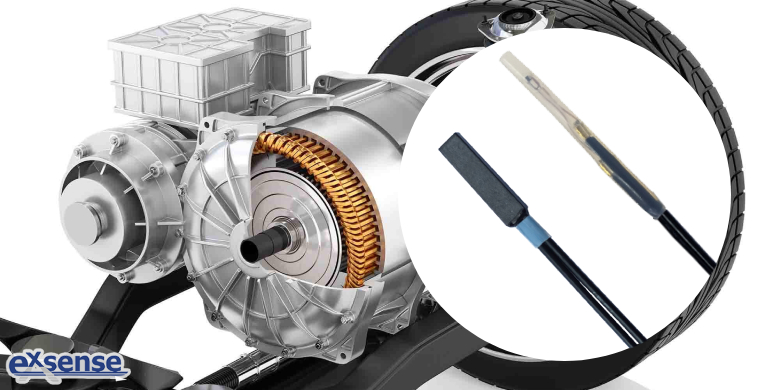
During operation, the drive motor of electric vehicle releases heat in the winding copper loss, core loss, and mechanical loss, especially under complex conditions such as high-load acceleration and continuous climbing, where internal motor temperature rise is particularly prominent. To achieve effective thermal management, EXSENSE automotive-grade NTC temperature sensor needs to be installed for temperature monitoring to prevent drive motor failures.
The installation position of EXSENSE automotive-grade NTC temperature sensors in electric vehicle drive motor is very carefully selected, typically installed at key temperature measurement points such as stator winding, bearing housing, and housing. Placing the NTC temperature sensor on the surface of the stator winding allows direct sensing of temperature changes, as winding is one of the main heat sources during motor operation. Real-time monitoring of its junction temperature is crucial for assessing motor operating status. Installing EXSENSE temperature sensor at bearing housing can monitor operating temperatures. Abnormal bearing temperature rises often indicate lubrication issues or mechanical faults, allowing early detection to effectively prevent serious damage. When NTC performs temperature detection in the drive motor, the resistance value changes are converted into voltage signals, which is then converted into digital signals transmitted to the electronic control system via the ADC. The system implements a tiered protection strategy based on temperature data. When the temperature reaches the warning threshold, corresponding protection mechanisms are triggered, such as reducing motor power or starting the cooling system, to prevent motor overheating and damage. Currently, some design solutions also add predictive models trained on historical NTC temperature data, combined with real-time NTC readings from inverter switching devices to achieve online estimation and forward-looking regulation of stator winding temperature.
EXSENSE automotive-grade NTC temperature sensor can promptly detect abnormal temperatures of drive motor, providing solid assurance for safe operation. This process relies on:
1. Excellent reliability: EXSENSE drive motor temperature sensor uses IP68 sealed protection and meets AEC-Q200 testing requirements, ensuring stable operation in complex automotive environments and preventing long-term temperature monitoring, high humidity, vibration, and chemical contact that affect its temperature monitoring capability.
2. High Temperature Resistance: EXSENSE drive motor NTC uses high-temperature resistant encapsulation materials (glass/PPS resin), with an operating temperature range covering -40℃~200℃. This allows the temperature sensor to adapt to the high junction temperature environment of the motor and accurately feed motor temperature information back to the electronic control system.
EXSENSE Electronics has passed the IATF 16949 automotive industry quality management system certification. We operate strictly according to the VDA 6.3 standard and comply with RoHS environmental requirements. From material selection, packaging process to finished product testing, automotive-grade NTC temperature sensors undergo rigorous process control, maintaining stable resistance—temperature characteristics and long-term service life, providing continuous and accurate temperature monitoring for electric vehicle drive motor. The application of EXSENSE automotive-grade NTC temperature sensors in drive motors helps efficiently achieve balanced optimization of temperature monitoring accuracy, thermal management efficiency, and system safety.



 Email
Email EXSENSE Eva