



3D Printer Temperature Monitoring, Why NTC Temperature Sensor Has Become Mainstream Choice
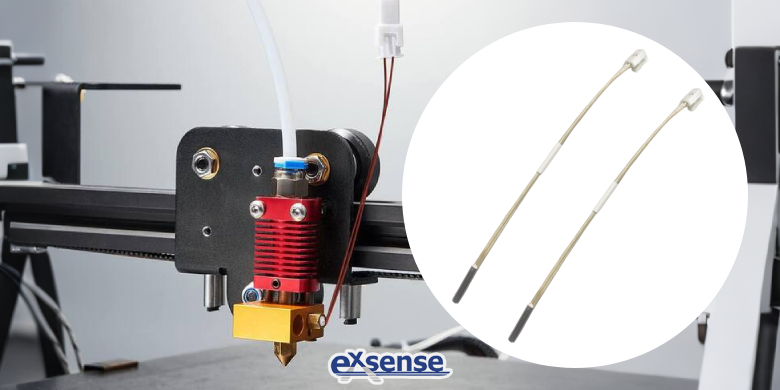
During the operation of a 3D printer, different printing materials have their own melting points and processing temperature ranges. If the temperature is too low, the material may not fully melt, leading to blockages or poor interlayer adhesion; if the temperature is too high, the material can degrade thermally, affecting the mechanical properties and surface quality of the printed part. EXSENSE high-temperature resistant NTC temperature sensors are highly sensitive to temperature changes, which is why they are used for temperature monitoring in mainstream 3D printer designs, ensuring print quality and stable operation.
To ensure real-time temperature monitoring, EXSENSE high-temperature resistant NTC sensors are installed in several key locations. First is the hotend of the 3D printer, typically using stainless steel tube-encased NTC, which is placed in the metal heating block to monitor its junction temperature, ensuring the printing material fully melts and effectively preventing blockages. Another key location is the heatbed, where EXSENSE temperature sensor is usually clamped to the print platform to ensure even heatbed temperature, preventing first-layer adhesion issues and reducing the risk of warping at the bottom of the finished product. Additionally, NTC temperature sensor is deployed inside the chamber to monitor environmental temperature fluctuations, helping the cooling and heating components maintain constant temperature control, and keep the 3D printer in a high-quality printing state.
Efficient operation of 3D printer relies heavily on EXSENSE high-temperature resistant NTC temperature sensors:
1. High-Temperature Resistance for Complex Conditions
During 3D printing, the hotend junction temperature can reach 200℃-300℃, which is a big challenge for NTC stability. EXSENSE temperature sensors feature radial glass-encased NTCs that can withstand temperature up to 350℃, maintaining accurate and stable temperature monitoring in high-temperature environments, effectively improving printing efficiency.
2. High Accuracy for Accurate Printing
Even small temperature deviations can affect 3D printing results. EXSENSE high-temperature resistant NTC with ±1% accuracy help the printer adjust the heating components promptly and precisely, improving printing success rates and quality.
3. Customization to Meet Diverse Printing Needs
EXSENSE high-temperature resistant NTC temperature sensors can be flexibly designed according to different 3D printer structures and performance requirements to suit various printing scenarios. This customization helps 3D printers better meet diverse printing needs, expand application fields, and bring 3D printing technology into more industries.
In summary, EXSENSE high-temperature resistant NTC sensors monitor temperature changes in key areas of 3D printers in real time, providing a solid foundation for efficient printing. As 3D printing technology continues to penetrate more advanced fields, temperature monitoring will face more differentiated requirements. EXSENSE will continue to optimize its customization capabilities, offering more reliable NTC temperature sensors for technological innovation and practical applications in the 3D printing industry.



 Email
Email EXSENSE Eva