



How Important are NTC Temperature Sensor for AI liquid-cooled Server Thermal Management?
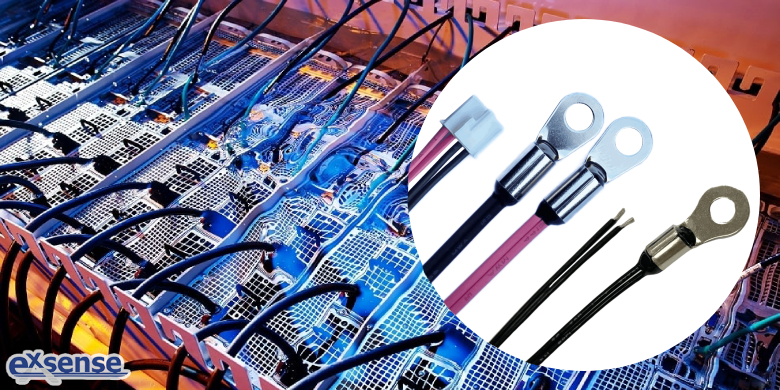
The power density of GPU and TPU is much higher than that of general-purpose CPU, and AI data center training or inference can make the heat load rise rapidly in a short time. The risk of local overheating between the cooling liquid loop, cold plate interface, and chips in AI liquid-cooled server does not automatically go away just because of liquid cooling. Against this backdrop, EXSENSE excellent-reliability NTC temperature sensors use the monotonic relationship between their resistance and temperature to perform real-time temperature monitoring inside AI liquid-cooled server. They serve as an irreplaceable sensing front-end for thermal protection and control loop, helping execute protective actions like frequency reduction or flow adjustment before the junction temperature exceeds the safe limit.
In AI liquid-cooled server, EXSENSE excellent-reliability NTC temperature sensors are installed in different positions for different monitoring purposes:
|
Temperature Monitoring Location |
NTC Installation Position |
Temperature Monitoring Purpose |
|
Surface of computing power devices |
Mounted on the surface of GPU, CPU, or the cold plate contact surface |
Monitor the temperature of the contact surface between the device and the cold plate to determine whether the chip is within the safe operating temperature range |
|
Cooling liquid pipeline |
Set in the liquid supply and return pipelines |
Measure the supply and return liquid temperatures, and evaluate the heat exchange status of the circuit in combination with the temperature difference |
|
Immersion cooling chamber |
Arranged at the inlet and outlet of immersion nodes |
Monitor the inlet and outlet temperatures of the coolant to assist in judging the immersion heat exchange effect and the changes in medium performance |
The real-time temperature monitored by EXSENSE excellent-reliability NTC temperature sensors is converted into signals via ADC and sent to the server or CDU controller. If the temperature exceeds preset threshold, the controller can trigger alarm and take targeted protective actions. Without NTC temperature feedback, it is difficult to adjust pump speed, flow rate and alarm strategy based on actual temperature conditions. The stable operation of AI liquid-cooled server depends on EXSENSE temperature sensors:
1. Excellent Reliability for Long-Term Data Center Operation
NTC probes are exposed to cooling liquid for long periods and face stresses like temperature cycling, humidity intrusion, and electromagnetic interference. EXSENSE thermistors are made of highly stable NTC semiconductor ceramic materials, encapsulated in IP68-rated metal housings. Under high-stress test conditions, resistance drift is low, effectively reducing the risk of unexpected downtime caused by inaccurate temperature measurement.
2. Fast Response to Rapid Load Temperature Fluctuations
The transient nature of AI workloads means that temperature signals matter not just for accuracy but also for speed. EXSENSE temperature sensors are highly sensitive to slight temperature changes, with millisecond-level response times that help control system quickly detect local hot spots, reduced heat exchange, or abnormal coolant conditions, leaving enough time for pump/valve adjustments and threshold alarm.
Improving cooling capacity in AI liquid-cooled server does not make temperature monitoring less necessary; Instead, it highlights the importance of monitoring speed and reliability in system design. In this context, EXSENSE excellent-reliability NTC temperature sensors should not be seen merely as "temperature measurement components" but as crucial parts of the liquid-cooling control loop. EXSENSE excellent-reliability NTC temperature sensors transform hard-to-observe temperature information into collectible and comparable electrical signals, enabling AI liquid-cooled server to maintain high computational efficiency within safe operating limit.



 Email
 EXSENSE Eva